Overhead during frigid January evenings lie quite a few notable constellations of Greek myth. King Cepheus and Queen Cassiopeia, rulers of Aethiopia, remain high in the northern sky as they as they march around the North Star. The winged horse Pegasus and princess Andromeda gradually move more westward with each passing night, and trailing them is the heroic Perseus, slayer of the gorgon Medusa. All these constellations hold a treasure trove of deep sky wonders, and aside from the bright Andromeda Galaxy, most require a telescope to even catch a faint glimpse; however, Perseus offers us a sight that only requires good eyesight and dark skies – the Double Cluster.
The Double Cluster has been known to observers for thousands of years thanks to its relative brightness, appearing as a faint fuzzy patch in the band of the Milky Way. One of the earliest records of its sighting was by the Greek astronomer Hipparcos who recorded it just over two millennia ago. Though visible to the naked eye, a telescope with low magnification will reveal the splendor of the Double Cluster; however, a decent pair of steadied binoculars will provide a view that may prove even more spectacular. Thanks to its high latitude in Perseus, the Double Cluster is circumpolar (always above the horizon) for numerous locations in the Northern Hemisphere, making it visible at practically any time of year.
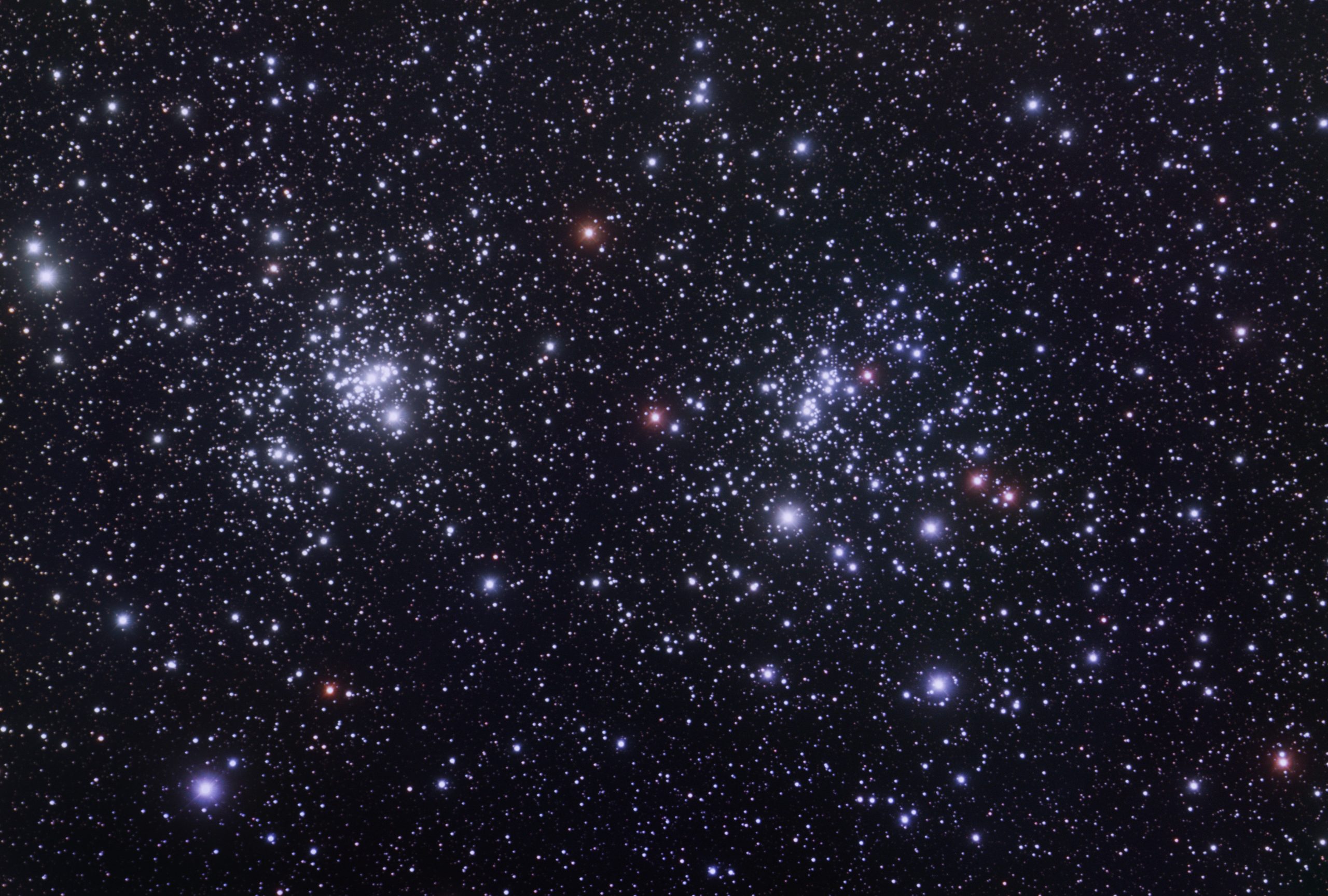
As the name suggests, the Double Cluster is indeed two separate star clusters. Both lie approximately 7,500 light-years from Earth, and their relative proximity to one another allows them to squeeze into the view of a small backyard telescope. They are gorgeous examples of open clusters, groups of thousands of relatively young stars whose members were all born at the same time of the same cloud of material. As they orbit in the disk of our Milky Way galaxy, the stars will gradually drift apart from one another as the clusters’ total masses (and corresponding gravities) are insufficient to keep the members corralled. Both clusters are only about 14 million years old, still quite young in terms of star lifetimes. If a typical star had a lifetime of a billion years (10 times shorter than our Sun’s lifetime), these stars would barely be considered toddlers.
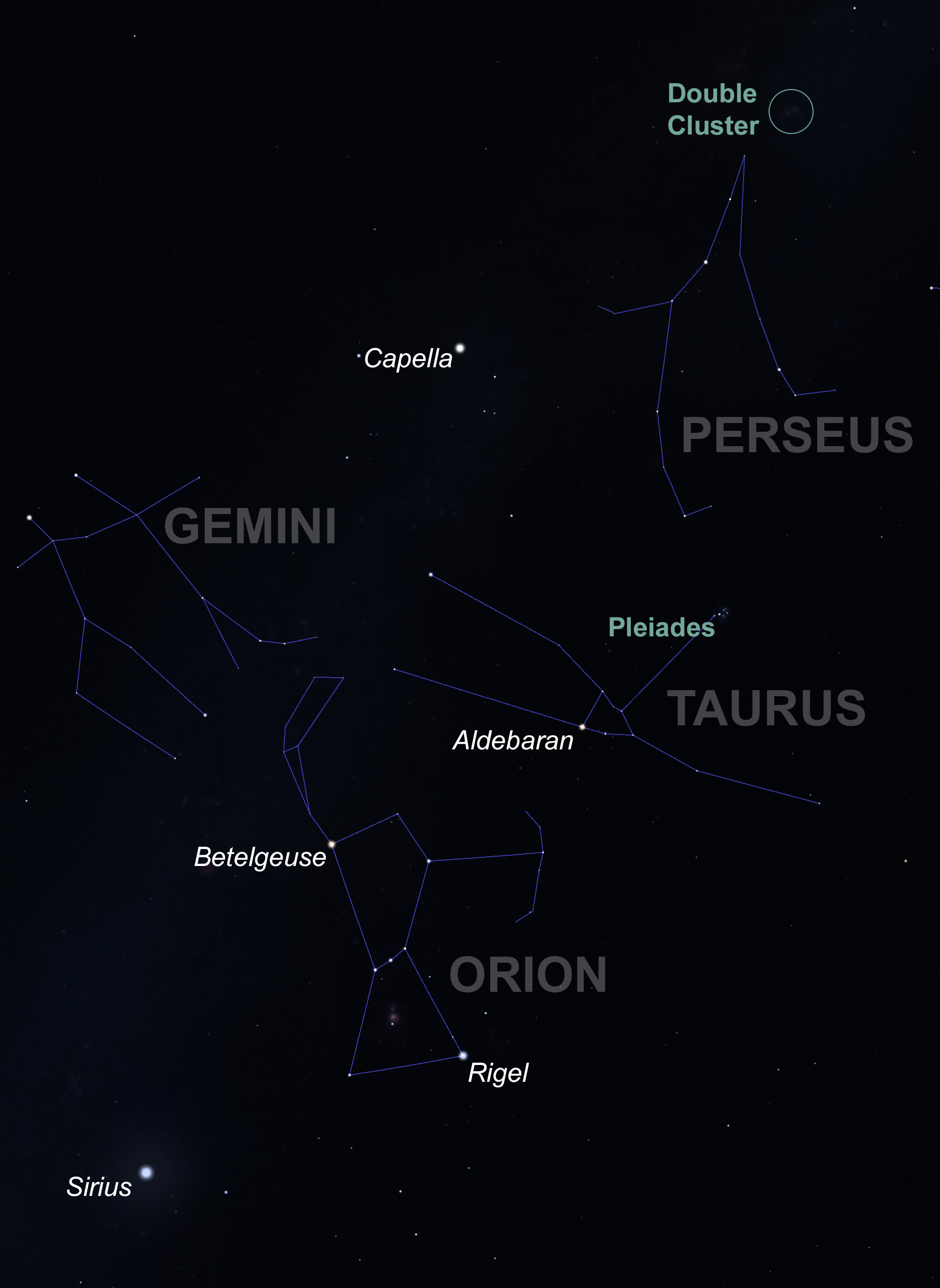
How do you locate the Double Cluster? Perseus lends a hand. To many, the brighter stars of the constellation form an asterism that looks somewhat like an arrow or a closed umbrella that conveniently points to the Double Cluster near the tip. If you look to star maps for additional help, note that they may refer to the clusters by other, more formal designations such as “NGC 884 and 869” or “h and Chi Persei.”